Showing posts with label feedback. Show all posts

Wednesday, December 11, 2019

An Argument Writing Battle Royale

Students don’t always like to spend a lot of time revising their writing. So, in the midst of creating an argument writing piece, I sought an engaging way for students to be more thoughtful about their revision.

After deciding how I would do this, I put students into groups of three and declared that they were teams.  They needed to help one another improve their writing to prepare what I dubbed the “Battle Royale.”

Students were hooked and took the role of giving and receiving peer feedback to heart.  Over the course of a class period, students read one another’s writing and gave feedback about both structure and content.  Students were listening carefully to one another and making many revisions to their work.
"Writing" by akrabat is licensed under CC BY-NC-SA 2.0 

The next time we met, I gave students 10 more minutes to prepare by giving feedback and revising their writing.  They were then ready for the “Battle Royale.”

Each student was assigned two numbers.  The roll of a die determined which student would take a turn.  In separate turns, the student chose by the die copied the introduction, a body paragraph, or the conclusion of their writing and pasted to a designated spot in shared Google Slides.  Once all were pasted, all students read all examples and selected the one they felt was the strongest.  Whichever team had their paragraph chosen as the strongest overall won the round and rolled a die to determine how many points the round was worth.

We proceeded that way so that multiple examples of each type of paragraph were shared by each team and a winner was declared.

Students not only worked well together by giving feedback in their groups, but they also had multiple exposures to other students’ work.  Seeing so many examples gave them greater insight into how they might revise their work further (which was the next step).

Approaching feedback and revisions in this manner resulted in students improving their writing more than they would have if a peer had given feedback in a more traditional way.  So, I will not hesitate in using this approach again.


____________________________________
If you have an effective way for peer  writing feedback or, if this post has generated some thoughts of your own, please share in the comments. I would appreciate hearing from you.

Saturday, August 5, 2017

Improving Feedback

I want my students to learn.


I want to empower my students as well.  


I want them to realize success as independent learners.


To realize these ends, I have encouraged student voice and choice more and more through the years. Last year, I handed the students the reins for a PBL experience around the United Nations Sustainable Development Goals.


To further students on their path of self sufficiency and to stimulate their growth as learners, I want to improve feedback in my classroom.  I want it to be more frequent, more efficient, and, most of all, used by students. (Too often, it seems, feedback given on their work is not thoughtfully considered by students, while feedback through conversation will only  be implemented in the moment.)


I look to the following three resources to help.


Creating a Culture of Feedback
To support feedback as a norm in my classroom and to enhance self sufficiency, students will need to self assess. This will require guided practice.


In Creating a Culture of Feedback by William M. Ferriter and Paul J. Cancellieri, I was reintroduced to the video Austin’s Butterfly: Building Excellence in Student Work.  The clip shows how students, with direction, can successfully provide specific, constructive feedback for peers and themselves. They need to build this skill to become better learners and to enhance their ability to produce high quality work independently.


By sharing the video with students, giving them guidance, and having them practice, students will gain confidence in their ability to both self assess and peer assess. As they become more comfortable with self assessment they will gain the ability to independently create higher quality work.


Live Exit Tickets with Google Forms
I was introduced to Kevin Zahner through Twitter and was excited to find his blog post on on exit tickets.

He describes how students complete their exit tickets with a Google Form and results go into a Google Sheet. Zahner links a sheet to the form that was created using Alice Keeler’s RosterTab Template.  This allows a separate tab in the sheet to be generated for each student.


He also creates a query so that the students are then able to see their own responses from the form in their own Google Sheet. The most compelling part is that the feedback the teacher provides within the individual student tabs can be seen immediately by the student.


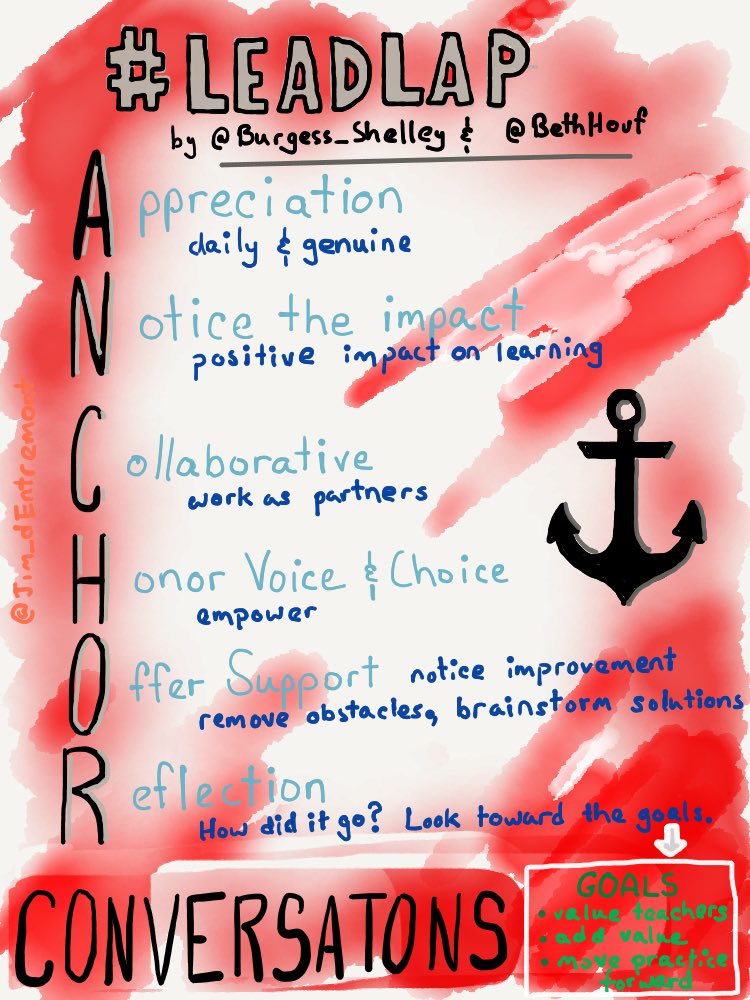
ANCHOR conversations.jpgThis could be used for either exit tickets or tickets to board. Giving immediate and ongoing feedback during class would give students the chance to act on that feedback. This should be highly effective and powerful.

ANCHOR Conversations
Lead Like a Pirate by Shelley Burgess and Beth Houf focuses on developing school culture. One thing they share is ANCHOR conversations.


Even though the ANCHOR Conversation practices are geared toward feedback between adults, I can see how students would benefit from similar guidelines. Embedded in ANCHOR conversations are developing trust, valuing the other person, remaining positive, and highlighting improvement.


I want to more routinely conference with students to provide them feedback. Using the ANCHOR Conversations guidelines will remind me how to maximize my interaction with students, making the feedback more productive.


I look forward to incorporating these three ideas so my students can receive better and more efficient feedback while developing their confidence as independent learners.


If you have had success having students use effective feedback, or if this post has generated some thoughts of your own, please share in the comments. I would appreciate hearing from you.


Sunday, May 22, 2016

Students Appreciate Meaningful Feedback

Students often ask about grades:

“Is this graded? How much is this worth?”

I readily reply, “Does it matter?”

“Yes,” they say.

“Will you do better work and learn more?”

“Yes,” they often respond.

“Then your work is graded.”

IMG_4407_picmonkeyed.JPG
I don’t like grades.

Does that assessment show they really know 90% of that topic? Does a conglomeration of grades averaged together actually show how well they understand.

This year I’ve had several serious conversations about eliminating grades with my students. They agree that it would be better - though, despite my clarification, I think some still don’t realize it does not mean the absence of learning and struggling with content.  (The big concern for some is getting into a good college. They are seventh graders! So much pressure they are putting on themselves.)

These conversations and my thoughts about grading led me to read Hacking Assessment: 10 Ways to Go Gradeless in a Traditional Grades School by Starr Sackstein.

A quick and practical read, Hacking Assessment offers tips to help you go gradeless. I’m not there yet, but it gave me lots to chew on and some things I could try right away.

When assessing, I had already removed a grade equivalent on rubrics, instead indicating level of mastery. I also had stopped indicating a grade on student work. They would have to look at the online grading portal to see that. I wanted students to focus on their work, their learning, and my feedback.

Sackstein discusses feedback in Hacking Assessment.  She references work by  Aric Foster and Mark Barnes around detaching the assessor from assessment:

The process taken during assessment is to “merely record what I see, how the work does or does not address standards, resources to pursue to amend areas of concern, and a new plan for resubmitting the work. My goals are to keep my comments as objective as possible,....while not judging harshly or praising superfluously.”

As a start, I latched on to the idea of providing feedback in the form of “I see” and “I don’t see,” referencing the standards and expectations. For example:

  • I see you have two specific examples to support your first reason.
  • I do not see effective use of transitions.

I found that this focused effort on feedback detached me more from the process of assessment.  I also found that it was more efficient and quicker to provide feedback in this manner. I was not longer riddling the students’ work with comments. Instead, it was a more global look at their overall work as related to the standards, expectations, and rubric.

I was pleased with my efforts, pleased at the ease of giving feedback in this manner, and hopeful the students would find it useful. So, after the students experienced this method of feedback, I felt compelled to ask them what they thought of it.

Their experience was literally 100% positive. Here are some comments:

  • I like this feedback because it showed us what we clearly did or didn’t do.  When it's just the rubric it tells us a list of things we could have done wrong, while this was clear.  It made it easier to improve because we know what to fix.
  • I like this style of feedback because I can figure out exactly what I did wrong and how I would be able to get there. Knowing exactly what I did wrong lets me know what I’m supposed to do to meet exemplary.
  • I liked the way you presented feedback because it helped me realize the things that are good in my writing and the things that I can work on.  Now I know some things I do should stay the same and some things I can change to make my writing a solid piece.
  • I did like this type of feedback because it is very straightforward and explicit.  This helps me better understand what I didn’t and did do well on.

I am going to continue this method of feedback as students are completing work and when they are finished.  I hope to incorporate other aspects of Barnes’ work such as providing resources and actions to encourage improvement and providing specific focus areas to resubmit (rather than the entire piece).

These efforts should help move me toward a gradeless classroom that focuses on rich feedback, growth, and learning and is student centered. Students will probably react favorably even if parents initially may respond negatively and administrators may be reluctant.

I look forward to this next phase of my journey.


If you are going gradeless or revamping how you give feedback, or if this post has generated some thoughts of your own, please share in the comments. I would appreciate hearing from you.


Related Posts Plugin for WordPress, Blogger...