Monday, February 15, 2016

Engage Your Students in Writing

Do you want your students to write effortlessly?

Jon Corippo shared 8 pARTS grammar at BLC15 last summer, and I was intrigued.

The basic idea is to get students to produce rich writing by having them practice often with highly stimulating images as the prompt.

Let me tell you...my students were tremendously engaged. They not only took to writing like they were writers, but they also were having fun - almost like they wanted to write.

I started with a picture of kids being mischievous that Corippo had shared (see it here). The students saw it projected on the board as they came in, and it immediately conjured conversation. I then had them recall the eight basic parts of speech and used the poem (linked here) to refresh any rusty recollections.

Then, the fun began.

Prompted by the image, students shared their ideas as I filled in this template:

8pARTSgrammar.png
  • caveman sentence (grunts included)
  • three verbs - and associated adverbs
  • three nouns - and associated adjectives
  • pronouns
  • conjunctions
  • prepositions
  • interjections


Some struggled to participate accurately. But, hey, that’s what we were doing this for. They got the clarification they needed - especially about adverbs.

After we completed the template together, they wrote. And they wrote, and they wrote. Not one student struggled to begin or follow through. I was amazed at how they took to the writing.

And the results were spectacular. The writing was much more descriptive and rich than I was used to from my students. (There were some punctuation errors….but one step at a time.) They were using the parts of speech correctly, and their writing was more dynamic.  One example follows:

Charles and his acquaintance Bobby crudely redecorate his living room with the thick, white paint. Bobby was at Charles’ house and they were bored, so they decided to have a little fun. All of a sudden Charles’ mom burst into the room and shouted, “Golly!”

Charles looked up from the paint he was now spreading on the small television as terror crossed his face. He was in big trouble. Charles’ mom looked at the room in shock and thought to herself about how the children were being annoying and messy like the presidential candidates she was listening to on the radio just before. She quickly took out her phone and snapped a picture to put on Instagram where she now had a whopping 23 followers! She then walked over to the boys to begin scolding them when she slipped on the still wet paint and face-planted onto the floor. The boys took this as a cue to run out of sight of the angry woman.

The key, clearly, is finding highly engaging media to stimulate their writing.  In addition, the expectation for writing is only a paragraph, so students are getting a quick burst of practice.  By doing it often enough, I can see that students will become better writers.


If you have used @jcorippo ‘s  8 pARTS grammar to enhance students learning or, if this post has generated some thoughts of your own, please share in the comments. I would appreciate hearing about them.

Monday, February 8, 2016

Student Created Content: Infographics

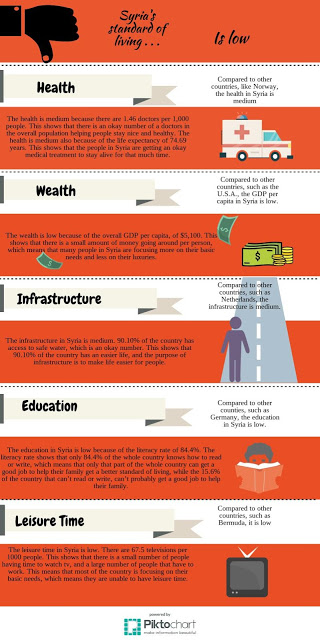
Syria's standard of living.jpegTechnology in the classroom is best used when blended in as a tool that enhances learning. To that end I decided to expose my students to infographics.  They had had a little experience viewing them to gather information, and I let them loose to create their own.
Usually, students start to put together their “projects” prior to being well versed in the topic.  They love to incorporate colors, images, and fonts. Knowing that all products depend on the information and understanding the students have, and to prevent them from being distracted by the glitz of making the product, I didn’t even let them in on the fact they would be creating infographics until I felt comfortable with their information and understanding.
I broke the information gathering, processing, and synthesizing into steps and did check-ins along the way. This ensured that students were on track with their understanding.
France Infographic.jpegStudents loaded the Piktochart app onto the classroom Chromebooks and accessed it with their school accounts.  Trusting the students to figure the program out and to support one another, I told them they would be familiar with most of the tools in Piktochart. The only features I demonstrated to the students was how to add another block to extend the infographic and how to copy a block so they could repeat a design.  I also told them to let me know if they needed help.
The students were largely independent and problem solved individually and with their neighbors. I guided them whenever they ran into a roadblock.
Students were very successful creating attractive and effective infographics.  They enjoyed the blending of words, images, graphics, and colors. They had to consider effective design to balance these features in an organized and appealing manner. When questioned by a colleague visiting to see them in action, students explained how they envisioned how they could create infographics in his class and others.
Producing infographics is a creative and engaging process for students which emphasizes technology as a productivity tool, can demonstrate student understanding, and has students practice real-life skills.


If you have used infographics to enhance students learning or, if this post has generated some thoughts of your own, please share in the comments. I would appreciate hearing about them.

Friday, February 5, 2016

BreakOut EDU: Stimulating Students' Thinking


BreakOut EDU offers curriculum related challenges for students, staff, or general team building.  The basic objective is to figure out clues and solve puzzles so you can open the box locked with several locks. Instead of purchasing a kit from them, I followed their guide to purchase materials to put together my own.  

IMG_4173.PNG
Students working a lock to see if they solved the puzzle correctly.
I reviewed the activity options, chose one to fit my needs, set up the challenge, introduced the concept to the students, and let them have at it.  Students were highly engaged, had fun with the puzzles and clues, and felt the excitement of the timer ticking away.


The benefits of BreakOut EDU are that students have fun, practice critical thinking, enhance their skills working as a member of a team, and can even review some content. We definitely have to work in some more break outs!


Student reactions to participating in the experience follow:


  • I liked this activity because it was something we’ve never done before, and it was challenging, and I like to be challenged.
  • The timer made some people panic, and so they didn’t think clearly.  Other than that it was really good.
  • Breakout was a challenging activity with clues and locks and problem solving.  Indeed it was hard.  It was a very fun activity that I would recommend to a a lot of people that like spy related things.  You really get the experiences that you’re actually under pressure.
  • The Breakout activity was very engaging and thoughtful.
  • The experience was fun.  We put our heads together and got as far as we could.
  • This experience helped me work on my teamwork skills.  Also, I got to have fun while working on something that challenged me as an individual.
  • It was fun to use skills from past experiences.
  • This was a fun way to build our teamwork skills and remember what we learned in sixth grade. The challenge got us to problem solve.
  • I think that it was fun and mysterious and also challenging.
  • The experience was fun to work together and solve the puzzles to open the locks in a certain amount of time. The only problem was that we weren’t always listening to each other.


If you have used BreakOut EDU or other challenges to enhance students’ experiences or, if this post has generated some thoughts of your own, please share in the comments. I would appreciate hearing about them.

Sunday, January 10, 2016

Three Pressing Goals to Accomplish This Year

Touching Students’ Hearts


This is always a pressing goal.


Students need to feel valued and need to value others. Each year I try to impress upon them that they are incredibly powerful beings who are capable of making an impact on the world - right now.


IMG_3534.PNGIn addition to day-to-day interactions, I show them examples of other young people who are doing just that. Malala is a powerful example. But I also show them that impacting the world can happen in smaller ways, too. Georgia orphan's mission: Make others smile moved many of my students, and the little boy’s simple actions are no less great than Malala’s.


I also use videos such as The Butterfly Circus to encourage students to see value in themselves and others. Some students are moved to tears.


The students are also encouraged to figure out what they are going to do with their knowledge as they learn in class. Currently, they have been investigating standard of living. I need to expose students to what others experience so the students may appreciate what they have. But more importantly, they need to be moved to consider how their new understandings are important and what they can do: What is their role in the world? What influence can they have? How can they make people’s lives better?


Already, this year, I have started down this path with my students. But I need to continue to move my students - to touch their hearts - so they are empowered to their greatness within and blossom as leaders.


Redesign the Classroom


I want them to collaborate. I want them to have choices. I want them to be curious and lead their own learning.


I think that a redesigned classroom can help facilitate those expectations.


The school district designed my classroom just like all others: one size fits all. They put in individual student desks and those lovely, hard, industrial chairs. There is a front of the classroom, defined by the projector and SmartBoard.


I want my students to be more comfortable in the classroom. I want better work surfaces to replace the desks. I want the classroom to have learning stations that are unique from one another: tables, “work benches,” multiple monitors/tvs from which they can present, places to investigate, places to create, and at least some cushions for those chairs, if not more comfortable spots in which they could choose to learn. I don’t want there to be a steadfast area of focus in the room - the front.


I want to sit down with my principal to talk through my reasons and my ideas. I’m hopeful that my physical classroom can start moving in the direction I would like it to.


Global Connections


I need to do a better job facilitating interactions between my students and the world. There is great value in the students realizing they are an influential piece of the world.


The students maintain blogs, but there is little interaction with them. I have encouraged parents to interact on the blogs with comments, but they seldom do. I need to push myself to tap other resources, such as social media and colleagues, that will generate a wider audience for the students’ blogs - so their sphere is influence broadens and they can see the impact of their positive digital footprint.


Another avenue I have to force myself to take is Skype. I have been hesitant to utilize Skype with my students because it is very much an unknown to me. I can often be very cautious and meticulous in getting myself familiar with something before I take the leap and challenge myself with the risk. This school year I have established a class twitter account (@Mr_dEsClass) through which I encourage and facilitate student tweets, but I feel it is high time I push my classes into Skype.


If you have three pressing goals you want to accomplish by the end of school this year or, if this post has generated some thoughts of your own, please share in the comments. I would appreciate hearing about them.



This post is inspired by Share #YourEduStory. The prompt from @bjornpaige was “What are your three most pressing goals between now and the end of the school year?

Sunday, January 3, 2016

One Word: A Focus for 2016

The new year always seems an appropriate time to reflect and refocus.  Although the summer is a great opportunity to do this prior to the beginning of a new school year, educators should remember that improvement is an ongoing process.  To that end, continuous reflection and refocusing throughout the year is powerful.  What better opportunity than ringing in the new year?


One word - focusing on one word as my inspiration in school for the year.  There were several that immediately came to mind: growth, transparency, empathy, student centered, collaboration, reflection.  But upon further reflection, I decided my one word would be LEADERSHIP.


SCHOOL
Tremendous changes have been afoot since the start of the school year. Not only have several teachers left midstream for other opportunities, but we entered the school year knowing our principal would be leaving in November.  After a search a new principal was hired.  A month after she started, the assistant principal announced that she, too, would be moving on to another opportunity.  With the start of school in January, we will welcome a new assistant principal.


The teachers are the continuity.  


The teachers are the consistency.  


The teachers are the ones who have the strongest relationships with the students.  


Leadership JFKEach of us needs to look upon ourselves as leaders.  Our collective leadership skills are what make the transition seamless with a new administrative team.  We can sustain and develop the necessary culture so that the students benefit, excel, and grow.  We do not need to wait for the administrative team, but, instead, can model for them an energetic, creative, enthusiastic, and nurturing environment.


Where others may be feeling out the new administrative team, I believe this is a great opportunity to develop a collaborative relationship within our school.  Each of us are leaders in some way. We can exercise our abilities in this moment to further our school culture.


CLASSROOM
The other draw to the word LEADERSHIP is the students.


I want my students to be leaders.  Not some of them, all of them.


So, I need to develop opportunities in which they can lead and develop their leadership skills.


The following are areas which will encourage their abilities as leaders:


Developing Voice
Students need to have input, both in class and in the world. They need to develop their voice by examining ideas and issues that are meaningful to them.  And they also need to express their thoughts about them so they can gain clarity around their ideas. Without giving them opportunities to develop their voices, students will struggle to exert themselves as leaders.  By emphasizing student voice, students will feel valued as a productive member of our classroom community, the school community, and the community outside our wall.


Challenge Themselves
It is one thing for the teacher to challenge the students, but it is a far greater opportunity for learning when students are challenging themselves.  Within the classroom, I can provide opportunities that allow for students to drive their own learning and challenge themselves.  By giving them options to impact the world, they will not only challenge themselves, but will also use their skills as leaders.  They will need to show the importance of what they are doing, will need to defend it, and will need command of written and spoken language.  


Risk Taking
Leaders take risks, and so should my students.  I want them to explore their own ideas.  I want them to try new things.  If the student hasn’t made a video before, they should try crafting one.  If the student doesn’t offer ideas much in class, they should be encouraged to do so.  If the student has not tried to convince the principal of implementing a new idea, the student should be given that opportunity.  Creating an environment in which students are comfortable to try new things - to take risks - is essential. Risk taking will develop students’ confidence in doing what they did not think was previously possible.


Perseverance
Students cannot give up easily.  Students need to be prompted to go back and rework their ideas with encouragement.  If they are going to challenge themselves and take risks, the work should be difficult.  They could become easily frustrated. They must relish the struggle instead. Promoting the idea that “You can do this,” is essential.  


Capacity
Building capacity in problem solving and skills is important.  Many skills are needed to efficiently consume information. Other skills are needed to efficiently create with this information.  Students need to build their capacity with these skills in order to better learn and better lead.  Giving them opportunities to problem solve - ideally with student generated problems - will build their capacity to come up with viable solutions.  


Each of these can be developed in students to enhance their abilities as learners and leaders. They each must, however, be modeled.


As a teacher, I can model these within the classroom. But I also need to remember that I need to exhibit the same as I demonstrate leadership within the school.


LEADERSHIP will be my focus for 2016, providing my students appropriate opportunities to develop their abilities as leaders and by taking opportunities myself to enhance school culture.

If you have "one word" you will focus on this year or have other goals for 2016 or, if this post has generated some thoughts of your own, please share in the comments. I would appreciate hearing about them.


This post is inspired by Share #YourEduStory. The prompt from @AppEducationFox was “What is your "one word" that will inspire you in your classroom or school in 2016?

Related Posts Plugin for WordPress, Blogger...