Showing posts with label #YourEdustory. Show all posts

Sunday, January 10, 2016

Three Pressing Goals to Accomplish This Year

Touching Students’ Hearts


This is always a pressing goal.


Students need to feel valued and need to value others. Each year I try to impress upon them that they are incredibly powerful beings who are capable of making an impact on the world - right now.
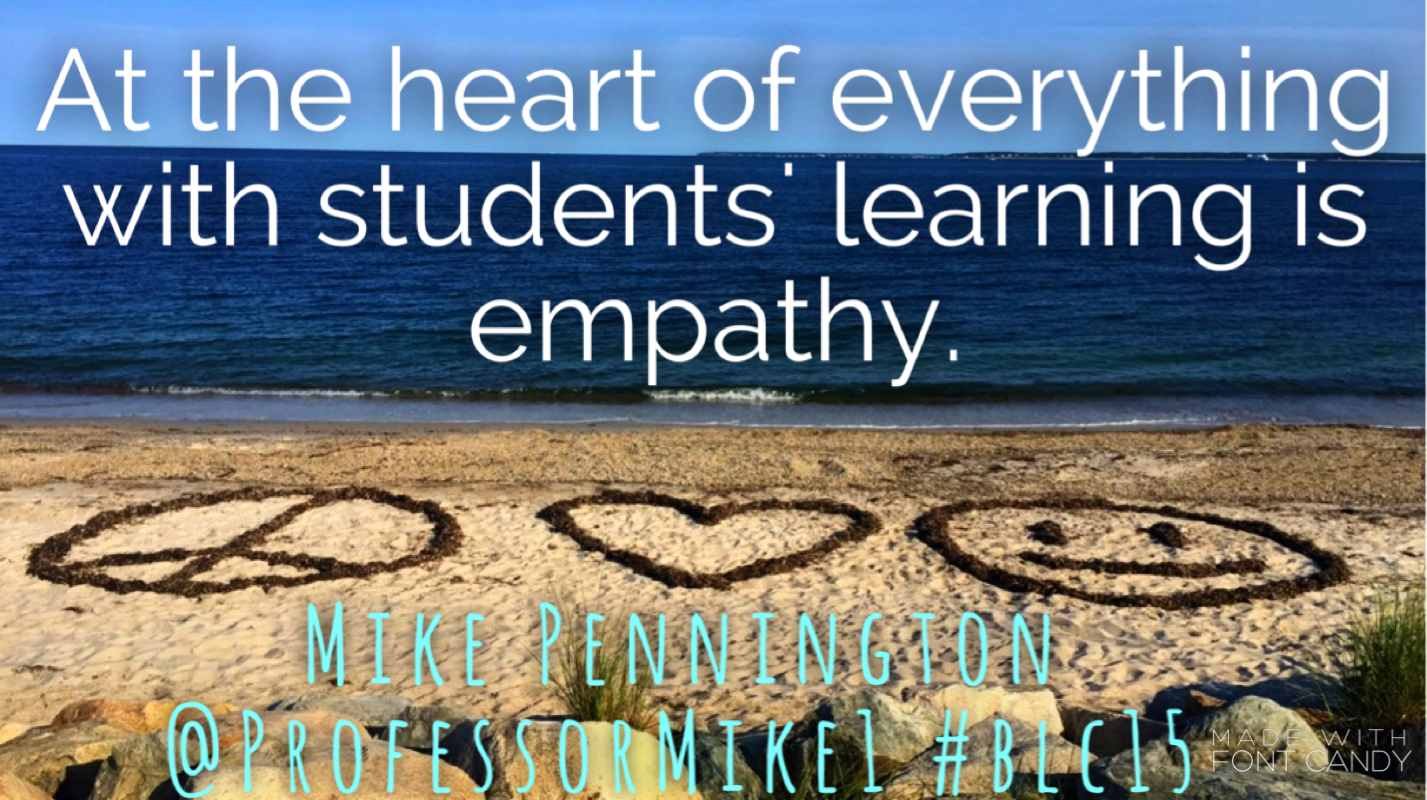

IMG_3534.PNGIn addition to day-to-day interactions, I show them examples of other young people who are doing just that. Malala is a powerful example. But I also show them that impacting the world can happen in smaller ways, too. Georgia orphan's mission: Make others smile moved many of my students, and the little boy’s simple actions are no less great than Malala’s.


I also use videos such as The Butterfly Circus to encourage students to see value in themselves and others. Some students are moved to tears.


The students are also encouraged to figure out what they are going to do with their knowledge as they learn in class. Currently, they have been investigating standard of living. I need to expose students to what others experience so the students may appreciate what they have. But more importantly, they need to be moved to consider how their new understandings are important and what they can do: What is their role in the world? What influence can they have? How can they make people’s lives better?


Already, this year, I have started down this path with my students. But I need to continue to move my students - to touch their hearts - so they are empowered to their greatness within and blossom as leaders.


Redesign the Classroom


I want them to collaborate. I want them to have choices. I want them to be curious and lead their own learning.


I think that a redesigned classroom can help facilitate those expectations.


The school district designed my classroom just like all others: one size fits all. They put in individual student desks and those lovely, hard, industrial chairs. There is a front of the classroom, defined by the projector and SmartBoard.


I want my students to be more comfortable in the classroom. I want better work surfaces to replace the desks. I want the classroom to have learning stations that are unique from one another: tables, “work benches,” multiple monitors/tvs from which they can present, places to investigate, places to create, and at least some cushions for those chairs, if not more comfortable spots in which they could choose to learn. I don’t want there to be a steadfast area of focus in the room - the front.


I want to sit down with my principal to talk through my reasons and my ideas. I’m hopeful that my physical classroom can start moving in the direction I would like it to.


Global Connections


I need to do a better job facilitating interactions between my students and the world. There is great value in the students realizing they are an influential piece of the world.


The students maintain blogs, but there is little interaction with them. I have encouraged parents to interact on the blogs with comments, but they seldom do. I need to push myself to tap other resources, such as social media and colleagues, that will generate a wider audience for the students’ blogs - so their sphere is influence broadens and they can see the impact of their positive digital footprint.


Another avenue I have to force myself to take is Skype. I have been hesitant to utilize Skype with my students because it is very much an unknown to me. I can often be very cautious and meticulous in getting myself familiar with something before I take the leap and challenge myself with the risk. This school year I have established a class twitter account (@Mr_dEsClass) through which I encourage and facilitate student tweets, but I feel it is high time I push my classes into Skype.


If you have three pressing goals you want to accomplish by the end of school this year or, if this post has generated some thoughts of your own, please share in the comments. I would appreciate hearing about them.


This post is inspired by Share #YourEduStory. The prompt from @bjornpaige was “What are your three most pressing goals between now and the end of the school year?”

Sunday, January 3, 2016

One Word: A Focus for 2016

The new year always seems an appropriate time to reflect and refocus.  Although the summer is a great opportunity to do this prior to the beginning of a new school year, educators should remember that improvement is an ongoing process.  To that end, continuous reflection and refocusing throughout the year is powerful.  What better opportunity than ringing in the new year?


One word - focusing on one word as my inspiration in school for the year.  There were several that immediately came to mind: growth, transparency, empathy, student centered, collaboration, reflection.  But upon further reflection, I decided my one word would be LEADERSHIP.


SCHOOL
Tremendous changes have been afoot since the start of the school year. Not only have several teachers left midstream for other opportunities, but we entered the school year knowing our principal would be leaving in November.  After a search a new principal was hired.  A month after she started, the assistant principal announced that she, too, would be moving on to another opportunity.  With the start of school in January, we will welcome a new assistant principal.


The teachers are the continuity.  


The teachers are the consistency.  


The teachers are the ones who have the strongest relationships with the students.  


Leadership JFKEach of us needs to look upon ourselves as leaders.  Our collective leadership skills are what make the transition seamless with a new administrative team.  We can sustain and develop the necessary culture so that the students benefit, excel, and grow.  We do not need to wait for the administrative team, but, instead, can model for them an energetic, creative, enthusiastic, and nurturing environment.


Where others may be feeling out the new administrative team, I believe this is a great opportunity to develop a collaborative relationship within our school.  Each of us are leaders in some way. We can exercise our abilities in this moment to further our school culture.


CLASSROOM
The other draw to the word LEADERSHIP is the students.


I want my students to be leaders.  Not some of them, all of them.


So, I need to develop opportunities in which they can lead and develop their leadership skills.


The following are areas which will encourage their abilities as leaders:


Developing Voice
Students need to have input, both in class and in the world. They need to develop their voice by examining ideas and issues that are meaningful to them.  And they also need to express their thoughts about them so they can gain clarity around their ideas. Without giving them opportunities to develop their voices, students will struggle to exert themselves as leaders.  By emphasizing student voice, students will feel valued as a productive member of our classroom community, the school community, and the community outside our wall.


Challenge Themselves
It is one thing for the teacher to challenge the students, but it is a far greater opportunity for learning when students are challenging themselves.  Within the classroom, I can provide opportunities that allow for students to drive their own learning and challenge themselves.  By giving them options to impact the world, they will not only challenge themselves, but will also use their skills as leaders.  They will need to show the importance of what they are doing, will need to defend it, and will need command of written and spoken language.  


Risk Taking
Leaders take risks, and so should my students.  I want them to explore their own ideas.  I want them to try new things.  If the student hasn’t made a video before, they should try crafting one.  If the student doesn’t offer ideas much in class, they should be encouraged to do so.  If the student has not tried to convince the principal of implementing a new idea, the student should be given that opportunity.  Creating an environment in which students are comfortable to try new things - to take risks - is essential. Risk taking will develop students’ confidence in doing what they did not think was previously possible.


Perseverance
Students cannot give up easily.  Students need to be prompted to go back and rework their ideas with encouragement.  If they are going to challenge themselves and take risks, the work should be difficult.  They could become easily frustrated. They must relish the struggle instead. Promoting the idea that “You can do this,” is essential.  


Capacity
Building capacity in problem solving and skills is important.  Many skills are needed to efficiently consume information. Other skills are needed to efficiently create with this information.  Students need to build their capacity with these skills in order to better learn and better lead.  Giving them opportunities to problem solve - ideally with student generated problems - will build their capacity to come up with viable solutions.  


Each of these can be developed in students to enhance their abilities as learners and leaders. They each must, however, be modeled.


As a teacher, I can model these within the classroom. But I also need to remember that I need to exhibit the same as I demonstrate leadership within the school.


LEADERSHIP will be my focus for 2016, providing my students appropriate opportunities to develop their abilities as leaders and by taking opportunities myself to enhance school culture.

If you have "one word" you will focus on this year or have other goals for 2016 or, if this post has generated some thoughts of your own, please share in the comments. I would appreciate hearing about them.


This post is inspired by Share #YourEduStory. The prompt from @AppEducationFox was “What is your "one word" that will inspire you in your classroom or school in 2016?”

Tuesday, December 29, 2015

#YourEduStory: Taking a Peek at Myself

#YourEduStory has presented a good opportunity to look internally and reflect.


By having access to weekly prompts, I was able to think more about my practices and approaches to teaching.  The questions and prompts promoted my own thinking and pushed me to examine my role as a teacher.  
IMG_2981_picmonkeyed.jpg

The reflections tended to reinforce that I believe my students are capable of incredible things and that mindful interaction with the students will help get them there.  The questions also revealed that I feel strongly in the approaches that I take to motivate students and promote their learning.  And, of course, new thinking was introduced and re-emphasized that I can always improve.


Some weeks I could not piece together thoughts that I felt would make a cogent blog post.  Those prompts, however, still provoked my thinking and reflection.


The format #YourEduStory provided also exposed me to others’ blogs.  Setting aside time to view their blogs and comment was difficult, but I found the comments made on their blogs stimulated positive interaction. The format was also appealing since the participants were creating the weekly prompts.


Although I only started engaging with #YourEduStory in the later part of 2015, I found it rewarding and worthwhile.  The value of the experience would encourage me to participate again in 2016.


If you have experiences that have provoked reflection on your teaching practice or, if this post has generated some thoughts of your own, please share in the comments. I would appreciate hearing about them.


This post is inspired by Share #YourEduStory. The prompt from @AppEducationFox was “What has the process of sharing #youredustory taught you? What have you learned? Would you do this again?”

Saturday, December 5, 2015

Thankful for Four


The four things for which I am most thankful for in my school:

Students
IMG_2887_picmonkeyed.jpgThe students make my teaching experience easy.  Although, there are struggles, frustrations, and concerns, those are far outweighed by positive interactions with the children.  Throughout my time as a teacher, they have been personable, appreciative, and curious.  They are willing to connect with me and are fun to be around.  They are willing to try new things and ask questions to delve into topics.  Clearly, teaching would be drudgery if students were not so engaging.


Colleagues
The people I work with are wonderful.  When you’re in dire straits, they are supportive.  When you need them to extend themselves, they are generous.  When you need them to give of themselves so you can pull off what you need to, they are generous.  When you need a sounding board or someone just to listen to you, they give you perspective, reassurance, and validation.  Without my colleagues’ expertise, I am not as capable.


Principals
The administrators that have lead my school have had one key element in common: each has allowed for innovation.  Even though they have had their own approaches, strengths, weaknesses, and philosophies, each has trusted and empowered the staff to try new ideas.  This has allowed me to make decisions in my own classroom to try the latest or less traditional approaches that have benefited the students.


Technology
I am fortunate to have a class set of Chromebooks for my students.  Each day the students are able to use them for reading, writing, investigating, creating, and publishing.  The technology has allowed me to give more immediate feedback to the students which has enabled them to learn more efficiently.  It also provides me with more time to engage with individual students as the classroom has become more student centered.  Using technology regularly also allows students greater opportunities for innovation during which they tap their critical thinking and creativity.


If you have things for which you are thankful in your teaching experience or, if this post has generated some thoughts of your own, please share in the comments. I would appreciate hearing about them.


This post is inspired by Share #YourEduStory. The prompt from @msventurino was “What are you most thankful for in your classroom, school, or your own education?”

Monday, November 2, 2015

Getting Better Together

Being connected as an educator can take on multiple forms.  


A teacher can be on twitter, maintain a blog, join a Google hangout, or use other social media.  With students, a teacher can have a class twitter account, have students maintain blogs, engage in mystery Skype, or use back channels among other activities.


In addition, students can use their smartphones to do things such as to record and share.  QR codes and Google Docs give teachers easy avenues to share with students and give feedback.  There are countless ways to be connected.

But, at its core, being connected comes down to one thing: getting better together.  Having crossed my mind in the past, I was reminded while reading Julie Vincentsen’s (@jvincentsen) blog. Whether using technology or not, education is all about getting better together.


Technology can enhance collaboration and even make it easier.  But it is not necessary for collaboration.  When we work together, we can learn and achieve far more than in isolation.  Even one who works without others, cannot escape the influence of others through interaction, readings, or video.  Students can bounce ideas off of one another, can clarify their ideas with one another, and can teach one another.  Likewise, educators can receive the same benefits when engaged with their students.


Some activities may use technology while others may not.  Ultimately, however, the goal remains the same:  improvement.  And it is enhanced by others.


Just like educators encourage our students to interact with others to improve their learning, educators must also look for others to help them with their learning and improvement.  By being connected, we are getting better together.   As Julie notes in her post, “@AmyHeavin writes: Through our conversation, we share insights & ideas. When we act on those ourselves, we grow. When we share others grow too!”

If you have thoughts about what it means to be connected or, if this post has generated some thoughts of your own, please share in the comments. I would appreciate hearing about them.


This post is inspired by Share #YourEduStory. The prompt from @christyfenne was “What does being "connected" mean to you?”

Monday, October 12, 2015

The Power of Student Driven Learning

Knowing that people are naturally inquisitive but that they don’t always have an avenue to delve into their unique interests, I wanted to give students an area to explore, discover, and create.  I have not felt successful with Genius Hour within my own classes as many students could not tap into their own passions and drive.  

My solution has been an after school club.

IMG_3670_picmonkeyed.jpg
Students can join me one afternoon a week to pursue any endeavor they wish.  I encouraged them to come immerse themselves in a venture of their choosing - if they want to learn coding or how build apps, if they want to learn how to juggle, if they want to learn video creation techniques, if they want to explore electronics, if they want to test a hypothesis, if they want to learn knitting, they can join me.  

I promised them that I would not be an expert on their passions but, instead, would be a support for them in their pursuits.  I would help point them in a direction or help them find answers to their questions.  

So far the response has been good - 10 to 15 students each week pursuing what they want to.  A few are investigating computer animation.  Some are looking into how to build smartphone apps.  One girl has explored crafting her own music on the computer.  A couple needed a break and took me up on some juggling instruction.

The students are engaged and enjoying themselves because they are driving their own learning and exploration.  It is truly powerful to see how absorbed they are and how eager they are to share their excitement and insights with their peers.

I feel fortunate that I can offer students a space to pursue their interests.  Academic standards can interfere during class, and some students seem to be rigid in their thinking and expectations, squelching their natural tendencies to question.  The students that visit me on Thursday afternoons, however, clearly want to play with knowledge and gain greater understanding.  They have questions they are pursuing, curious about the world just like an infant popping objects into her mouth to explore the world around her.

If you have #1CoolThing that has happened in your classroom this year or, if this post has generated some thoughts of your own, please share in the comments. I would appreciate hearing about them.


This post is inspired by Share #YourEduStory. The prompt from @teachfromhere was “Share #1CoolThing that has happened in your class/school/district this fall.”

Wednesday, October 7, 2015

Growth & Inspiration from Others

I refer to others’ blogs regularly.  They both inform and inspire.  Part of whom I am as a teacher is due to their willingness to share through their blogs.


The first blog I began to follow was Richard Byrne’s Free Tech 4 Teachers.  His work opened my eyes to the multitude of resources that exist which can enhance a teacher’s toolbox.  His daily review of tech tools and his tutorials are invaluable.  Nearly every day, there is something on his blog that makes me stop and pause, thinking, How can I use or do that in my classroom?”  My eyes have been opened to see the possibilities of technology in the classroom by Byrne.

Larry Ferlazzo’s Websites of the Day is another phenomenal blog.  Taking regular dips in his posts reap rewards as Larry Ferlazzo presents endless resources.  Some of the varying topics he addresses are student motivation, educational policy, ELLs, holidays, and his “best of” list of resources.  This just scratches the surface of what his site has to offer.  No matter the topic or subject area, Ferlazzo has curated resources for it.  Looking for something on metacognition?  How about movie clips of bad teachers?  Maybe you need “What If” history lessons?  Search his websites of the day to get yourself pointed in the right direction.

Certain needs led me to the first two blogs mentioned.  I have no idea what first led me to Paul Bogush’s Blogush.  Whatever it was, I am thankful.  Bogush wears his heart on his sleeve right where you can see his passion.  He is not afraid to put forth his opinion - that’s what a blog is for, right?  And his honesty is always rooted in what is best for his students and his own reflection.  He shares glimpses into his classroom and school through his blog and student videos that show he believes students are incredibly powerful beings capable of impacting the world as soon as they are ready.  In short, Paul Bogush makes me think about students and my own teaching.

This will be the third year my students keep blogs.  My former students who are now in eighth grade will be continuing their blogs with their current teachers.  I’m so pleased their current teachers have taken the opportunity to support the students’ blogging.  These blogs energize me as I gain greater insight about my students.  I also see my students opening themselves up to the world, inviting others to engage, trying to make an impact on the world, and crafting a positive digital footprint.  I will continue to encourage my students’ voices through blogging, as I have much to gain from their sharing.

If you do not currently follow some blogs, I encourage you to do so.  Check out the ones I’ve mentioned and seek others that help you to grow both personally and professionally.

If there are blogs that inspire you or, if this post has generated some thoughts of your own, please share them in the comments. I would appreciate hearing about them.


This post is inspired by Share#YourEduStory. The prompt from @bjornpaige was “Whose blogs do you draw inspiration from and why?”

Monday, September 28, 2015

Getting Students Ready for Their Future

Six qualities I can bring to my classroom to make students more engaged and prepared for their future:
  1. Relationships - Know and value students; build trust.
  2. Risk - Students can’t be scared to learn from failing; push them to stretch them.
  3. Student centered - Students are natural learners; let them drive their learning.
  4. Questioning - Learn better by asking your own questions, giving ownership and developing capacity to creatively problem solve and discover.
  5. Connections to the world outside our walls - Tap resources; make connections; build empathy and understanding; influence the world.
  6. Reflection - Enhance student learning as they consider what was learned and the process taken.

If you have ideas about what are the most important characteristics of instruction or, if this post has generated some thoughts of your own, please share them in the comments. I would appreciate hearing about them.


This post is inspired by Share#YourEduStory. The prompt was “In 100 words or less, describe the most important characteristics of 21st century instruction.”

Monday, September 7, 2015

Trying to Touch Students’ Hearts

As the new school year has started, my inclination is to be better than I was in previous years.  There are always so many different things floating through my mind to improve my instruction and the students’ experiences.  Among my myriad goals, I have prioritized two.

IMG_3656_picmonkeyed.jpg I want my middle school students to realize they can make their mark and influence the world - right now.  To set them off in that direction, they will gain exposure to ideas revealed by International Dot Day to help motivate them to be bold risk takers who can influence the world.  To connect it to the social studies curriculum, I want them to explore issues relating to geography that touch their hearts.  I hope they will be spurred on to try and make a difference in the world and be compassionate.  I want them to realize they have great power and influence as individuals and that they do not need to wait until their adulthood to start leaving their legacies.

Another opportunity I want to offer my students requires doing a better job of breaking down the walls of my classroom.  Currently, my students develop blogs with which they can interact with the world.  I need to do more to have others connect with my students via their blogs.  If I can take appropriate steps, students’ audiences will be broadened and they will connect with others more widely.  Students would also benefit from making connections through Skype.  I believe that meeting people from other places through video conferencing and their blogs will help draw the world nearer to them, make learning and understanding more personal, and, again, touch their hearts, spurring them on to deeper learning and greater accomplishments.

I look forward to bringing these opportunities to my students.  There is a lot of value to students understanding that they, too, can make a difference in the world.  By touching their hearts in dynamic ways, they should be more motivated to reach outside their comfort zones and make an impact on the world.

If you have found ways to touch your students' hearts or taken them beyond the walls of your classroom, or if this post has generated some thoughts of your own, please share them in the comments. I would appreciate hearing about them.


Related Posts Plugin for WordPress, Blogger...