Sunday, January 10, 2016

Three Pressing Goals to Accomplish This Year

Touching Students’ Hearts


This is always a pressing goal.


Students need to feel valued and need to value others. Each year I try to impress upon them that they are incredibly powerful beings who are capable of making an impact on the world - right now.
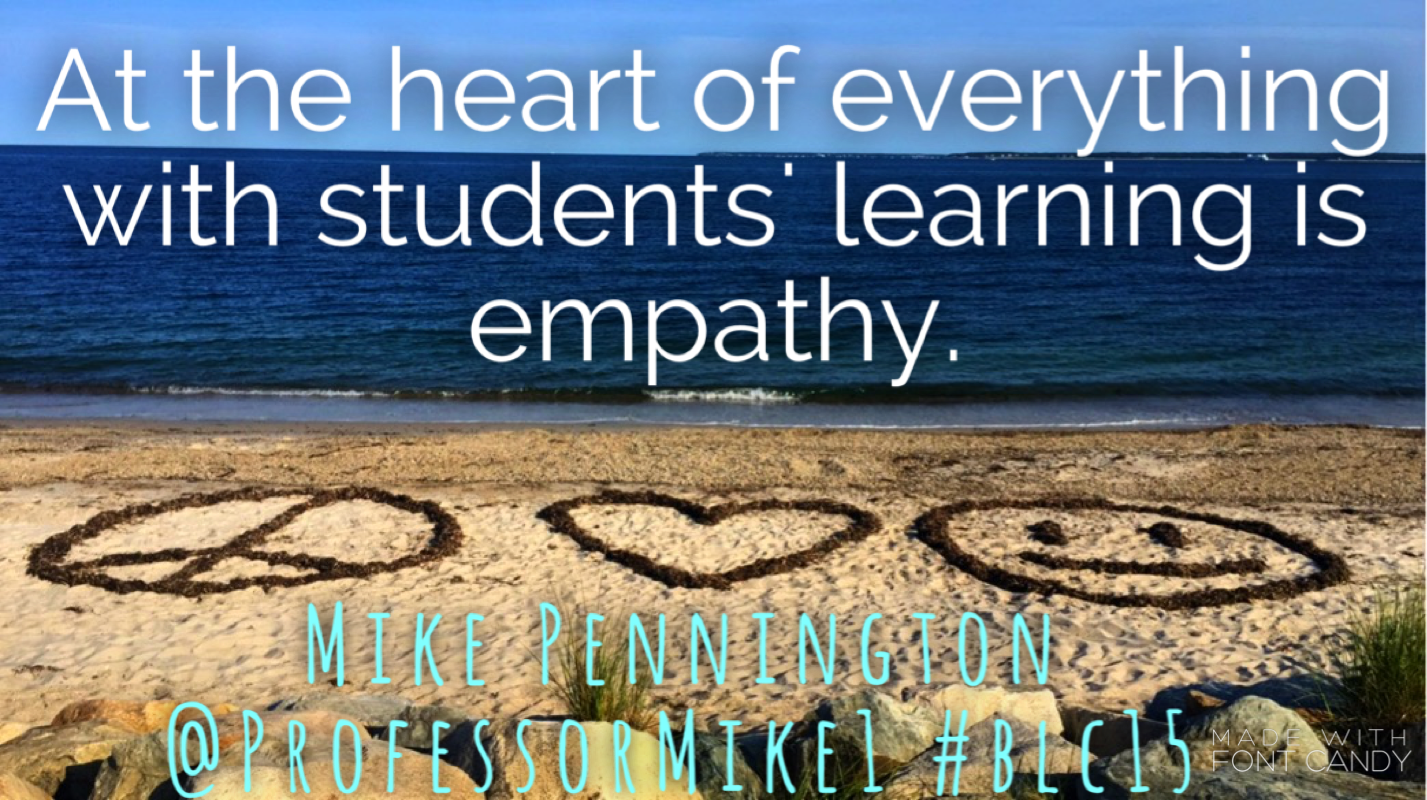

IMG_3534.PNGIn addition to day-to-day interactions, I show them examples of other young people who are doing just that. Malala is a powerful example. But I also show them that impacting the world can happen in smaller ways, too. Georgia orphan's mission: Make others smile moved many of my students, and the little boy’s simple actions are no less great than Malala’s.


I also use videos such as The Butterfly Circus to encourage students to see value in themselves and others. Some students are moved to tears.


The students are also encouraged to figure out what they are going to do with their knowledge as they learn in class. Currently, they have been investigating standard of living. I need to expose students to what others experience so the students may appreciate what they have. But more importantly, they need to be moved to consider how their new understandings are important and what they can do: What is their role in the world? What influence can they have? How can they make people’s lives better?


Already, this year, I have started down this path with my students. But I need to continue to move my students - to touch their hearts - so they are empowered to their greatness within and blossom as leaders.


Redesign the Classroom


I want them to collaborate. I want them to have choices. I want them to be curious and lead their own learning.


I think that a redesigned classroom can help facilitate those expectations.


The school district designed my classroom just like all others: one size fits all. They put in individual student desks and those lovely, hard, industrial chairs. There is a front of the classroom, defined by the projector and SmartBoard.


I want my students to be more comfortable in the classroom. I want better work surfaces to replace the desks. I want the classroom to have learning stations that are unique from one another: tables, “work benches,” multiple monitors/tvs from which they can present, places to investigate, places to create, and at least some cushions for those chairs, if not more comfortable spots in which they could choose to learn. I don’t want there to be a steadfast area of focus in the room - the front.


I want to sit down with my principal to talk through my reasons and my ideas. I’m hopeful that my physical classroom can start moving in the direction I would like it to.


Global Connections


I need to do a better job facilitating interactions between my students and the world. There is great value in the students realizing they are an influential piece of the world.


The students maintain blogs, but there is little interaction with them. I have encouraged parents to interact on the blogs with comments, but they seldom do. I need to push myself to tap other resources, such as social media and colleagues, that will generate a wider audience for the students’ blogs - so their sphere is influence broadens and they can see the impact of their positive digital footprint.


Another avenue I have to force myself to take is Skype. I have been hesitant to utilize Skype with my students because it is very much an unknown to me. I can often be very cautious and meticulous in getting myself familiar with something before I take the leap and challenge myself with the risk. This school year I have established a class twitter account (@Mr_dEsClass) through which I encourage and facilitate student tweets, but I feel it is high time I push my classes into Skype.


If you have three pressing goals you want to accomplish by the end of school this year or, if this post has generated some thoughts of your own, please share in the comments. I would appreciate hearing about them.


This post is inspired by Share #YourEduStory. The prompt from @bjornpaige was “What are your three most pressing goals between now and the end of the school year?

Sunday, January 3, 2016

One Word: A Focus for 2016

The new year always seems an appropriate time to reflect and refocus.  Although the summer is a great opportunity to do this prior to the beginning of a new school year, educators should remember that improvement is an ongoing process.  To that end, continuous reflection and refocusing throughout the year is powerful.  What better opportunity than ringing in the new year?


One word - focusing on one word as my inspiration in school for the year.  There were several that immediately came to mind: growth, transparency, empathy, student centered, collaboration, reflection.  But upon further reflection, I decided my one word would be LEADERSHIP.


SCHOOL
Tremendous changes have been afoot since the start of the school year. Not only have several teachers left midstream for other opportunities, but we entered the school year knowing our principal would be leaving in November.  After a search a new principal was hired.  A month after she started, the assistant principal announced that she, too, would be moving on to another opportunity.  With the start of school in January, we will welcome a new assistant principal.


The teachers are the continuity.  


The teachers are the consistency.  


The teachers are the ones who have the strongest relationships with the students.  


Leadership JFKEach of us needs to look upon ourselves as leaders.  Our collective leadership skills are what make the transition seamless with a new administrative team.  We can sustain and develop the necessary culture so that the students benefit, excel, and grow.  We do not need to wait for the administrative team, but, instead, can model for them an energetic, creative, enthusiastic, and nurturing environment.


Where others may be feeling out the new administrative team, I believe this is a great opportunity to develop a collaborative relationship within our school.  Each of us are leaders in some way. We can exercise our abilities in this moment to further our school culture.


CLASSROOM
The other draw to the word LEADERSHIP is the students.


I want my students to be leaders.  Not some of them, all of them.


So, I need to develop opportunities in which they can lead and develop their leadership skills.


The following are areas which will encourage their abilities as leaders:


Developing Voice
Students need to have input, both in class and in the world. They need to develop their voice by examining ideas and issues that are meaningful to them.  And they also need to express their thoughts about them so they can gain clarity around their ideas. Without giving them opportunities to develop their voices, students will struggle to exert themselves as leaders.  By emphasizing student voice, students will feel valued as a productive member of our classroom community, the school community, and the community outside our wall.


Challenge Themselves
It is one thing for the teacher to challenge the students, but it is a far greater opportunity for learning when students are challenging themselves.  Within the classroom, I can provide opportunities that allow for students to drive their own learning and challenge themselves.  By giving them options to impact the world, they will not only challenge themselves, but will also use their skills as leaders.  They will need to show the importance of what they are doing, will need to defend it, and will need command of written and spoken language.  


Risk Taking
Leaders take risks, and so should my students.  I want them to explore their own ideas.  I want them to try new things.  If the student hasn’t made a video before, they should try crafting one.  If the student doesn’t offer ideas much in class, they should be encouraged to do so.  If the student has not tried to convince the principal of implementing a new idea, the student should be given that opportunity.  Creating an environment in which students are comfortable to try new things - to take risks - is essential. Risk taking will develop students’ confidence in doing what they did not think was previously possible.


Perseverance
Students cannot give up easily.  Students need to be prompted to go back and rework their ideas with encouragement.  If they are going to challenge themselves and take risks, the work should be difficult.  They could become easily frustrated. They must relish the struggle instead. Promoting the idea that “You can do this,” is essential.  


Capacity
Building capacity in problem solving and skills is important.  Many skills are needed to efficiently consume information. Other skills are needed to efficiently create with this information.  Students need to build their capacity with these skills in order to better learn and better lead.  Giving them opportunities to problem solve - ideally with student generated problems - will build their capacity to come up with viable solutions.  


Each of these can be developed in students to enhance their abilities as learners and leaders. They each must, however, be modeled.


As a teacher, I can model these within the classroom. But I also need to remember that I need to exhibit the same as I demonstrate leadership within the school.


LEADERSHIP will be my focus for 2016, providing my students appropriate opportunities to develop their abilities as leaders and by taking opportunities myself to enhance school culture.

If you have "one word" you will focus on this year or have other goals for 2016 or, if this post has generated some thoughts of your own, please share in the comments. I would appreciate hearing about them.


This post is inspired by Share #YourEduStory. The prompt from @AppEducationFox was “What is your "one word" that will inspire you in your classroom or school in 2016?

Tuesday, December 29, 2015

#YourEduStory: Taking a Peek at Myself

#YourEduStory has presented a good opportunity to look internally and reflect.


By having access to weekly prompts, I was able to think more about my practices and approaches to teaching.  The questions and prompts promoted my own thinking and pushed me to examine my role as a teacher.  
IMG_2981_picmonkeyed.jpg

The reflections tended to reinforce that I believe my students are capable of incredible things and that mindful interaction with the students will help get them there.  The questions also revealed that I feel strongly in the approaches that I take to motivate students and promote their learning.  And, of course, new thinking was introduced and re-emphasized that I can always improve.


Some weeks I could not piece together thoughts that I felt would make a cogent blog post.  Those prompts, however, still provoked my thinking and reflection.


The format #YourEduStory provided also exposed me to others’ blogs.  Setting aside time to view their blogs and comment was difficult, but I found the comments made on their blogs stimulated positive interaction. The format was also appealing since the participants were creating the weekly prompts.


Although I only started engaging with #YourEduStory in the later part of 2015, I found it rewarding and worthwhile.  The value of the experience would encourage me to participate again in 2016.


If you have experiences that have provoked reflection on your teaching practice or, if this post has generated some thoughts of your own, please share in the comments. I would appreciate hearing about them.


This post is inspired by Share #YourEduStory. The prompt from @AppEducationFox was “What has the process of sharing #youredustory taught you? What have you learned? Would you do this again?

Saturday, December 5, 2015

Thankful for Four


The four things for which I am most thankful for in my school:

Students
IMG_2887_picmonkeyed.jpgThe students make my teaching experience easy.  Although, there are struggles, frustrations, and concerns, those are far outweighed by positive interactions with the children.  Throughout my time as a teacher, they have been personable, appreciative, and curious.  They are willing to connect with me and are fun to be around.  They are willing to try new things and ask questions to delve into topics.  Clearly, teaching would be drudgery if students were not so engaging.


Colleagues
The people I work with are wonderful.  When you’re in dire straits, they are supportive.  When you need them to extend themselves, they are generous.  When you need them to give of themselves so you can pull off what you need to, they are generous.  When you need a sounding board or someone just to listen to you, they give you perspective, reassurance, and validation.  Without my colleagues’ expertise, I am not as capable.


Principals
The administrators that have lead my school have had one key element in common: each has allowed for innovation.  Even though they have had their own approaches, strengths, weaknesses, and philosophies, each has trusted and empowered the staff to try new ideas.  This has allowed me to make decisions in my own classroom to try the latest or less traditional approaches that have benefited the students.


Technology
I am fortunate to have a class set of Chromebooks for my students.  Each day the students are able to use them for reading, writing, investigating, creating, and publishing.  The technology has allowed me to give more immediate feedback to the students which has enabled them to learn more efficiently.  It also provides me with more time to engage with individual students as the classroom has become more student centered.  Using technology regularly also allows students greater opportunities for innovation during which they tap their critical thinking and creativity.


If you have things for which you are thankful in your teaching experience or, if this post has generated some thoughts of your own, please share in the comments. I would appreciate hearing about them.


This post is inspired by Share #YourEduStory. The prompt from @msventurino was “What are you most thankful for in your classroom, school, or your own education?

Thursday, November 19, 2015

Invigorating Student Learning

Want to get your students’ blood pumping and energize them while they learn?


Transform your cooperative learning activity into a reality TV cooking competition.


I was introduced to John Corippo’s take on cooperative learning at the Blended Learning Communities conference this past July.  He transformed the jigsaw method of cooperative learning by using Iron Chef as an inspiration.


Students are given a task to complete within a group using content - the ingredients.  They have a time limit.  They’re even given a mystery ingredient.  Then they get 30 seconds apiece to present as part of their group.


chef working.png
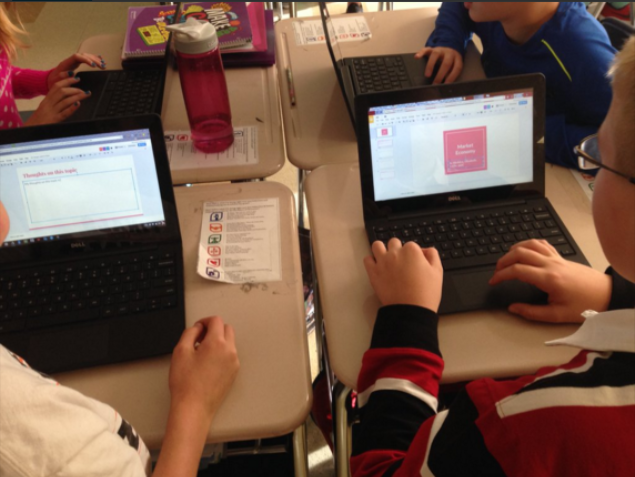
Creating the slide presentation.
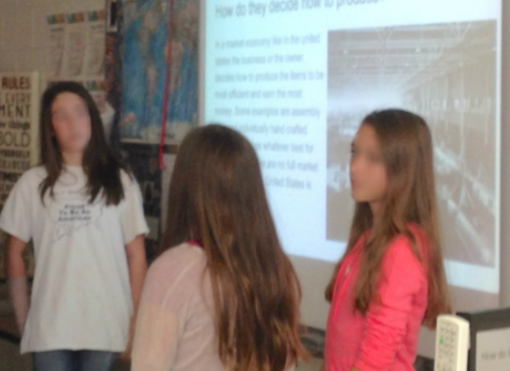
I took Corippo’s resources (You can find them at his site.) and altered them to meet my students’ needs.  I put students into groups of three or four and gave them twelve minutes to produce with Google Slides.  Each student was responsible for one slide with the expectation to include appropriate information and one image.  They also needed to use the “ingredient” from the mystery box on all slides.  When time was up, they would stop working.  Ready or not, it would be time to present.  Each group would come before the class, and each student would present his/her slide in 30 seconds or less.
chef quotes.png
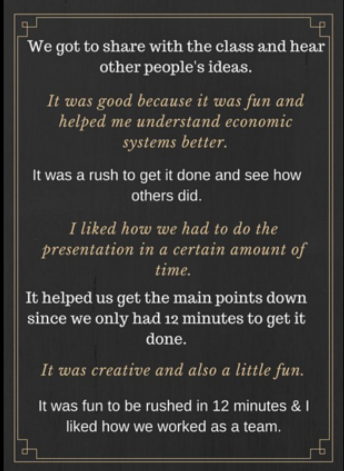
Comments from students about their experience.


After giving students the overview and the expectations and getting the timer ready, I announced, “Your twelve minutes starts….NOW!”  There was a slight pause as the class collectively took a breath, and, then, the students feverishly began their work.


The fast pace and feeling of competition ensnared the students. They were engaged, they were manipulating information, and they were interacting positively with their peers.  They handled the task well, even mustering the courage to present in front of their peers.  


The presentations were a bonus.  Not only did each student review information within the group, but every student in class had multiple exposures to information related to the topic when the different groups shared their understanding through the oral component.  To encourage listening - and because audiences always like to have their say in television competitions like American Idol or Dancing with the Stars - students were asked to rate each presentation on the following criteria via a Google Form:  content, presentation and creativity, and overall quality.  


chef presenting.png
Presenting to the class.
Although some students initially felt the pressure of time, I think that was worthwhile exposure for them as they often struggle to produce efficiently, taking far longer on tasks than I would expect.  They also realized that the time limit made it exciting. Overall, they gave positive feedback.


I recommend you check out Corippo's work. I certainly will be making the Iron Chef approach a permanent part of my lesson planning arsenal.


If you have highly engaging lessons or, if this post has generated some thoughts of your own, please share in the comments. I would appreciate hearing about them.


NOTE: Underlined portions indicate revisions made 11/20/15.
Related Posts Plugin for WordPress, Blogger...