Saturday, February 23, 2019

Fun! Low Key! Community Building! World Geography & Culture Night!

Inside the EarthView Globe
Each year, we organize a World Geography and Culture Night at my school. The idea was born out of the need to broaden our students horizons and expose them to different aspects of the world that they may not be aware of.

Although our evening has taken place in the winter or spring, planning starts over the summer and gets into full swing come September. Over the summer we determine the date of our event by booking the unique EarthView Globe. This 20 foot in diameter inflatable globe is a highlighted feature of the evening. Families have the opportunity to go inside the globe and hear from Bridgewater State University’s geographic experts. 


Other than making sure space is available for the evening, the next step is to reach out to staff members for support. We ask the staff to if they have ideas for a geography or culture related activity they would like to facilitate. We also offer the opportunity to facilitate simple activities that we already have prepared. This year, we had far more staff involvement than in the past. Their presence gave a far different feel to Geo Night. The night evolved into a schoolwide event, rather than a a social studies department event.

In addition to the EarthView Globe, we have several other consistent activities.

As a concluding activity to the evening, we have always had a special event. We have invited in performers which highlight culture in a manner that our students have never seen before: Taiko drumming, traditional dancing, etc. More recently, we have concluded with a Mystery Skype. We have Skyped with places such as Singapore and China. The time difference plays into our favor during an evening event, and the crowd is always enthusiastic as they try to figure out the location.

Our reading specialist and assistant principal (the Crazy Reading Ladies) have also developed an activity each year. They tie it into the book that is the current school-wide read (#AllIn19). This year, students created six word stories based on pictures of shoes. The activity was connected to Salt to the Sea by Ruta Sepetys which had a character philosophize that you can tell a person’s story by the shoes that they wear. Families perused a variety of shoes from different cultures and economic classes to devise their six word stories.

The school's Spanish teachers also offer an activity each year. For our most recent evening, they engaged students by crafting fiesta themed flowers. The room was abuzz with activity proving the flowers were a huge hit. In the past, they have engaged students with Spanish dancing and Day of the Dead activities.

Other standbys include landform bingo and geo bee questions. A newer addition has been a BreakOut room that is connected to some other place in the world. This year we had multiple breakout boxes running at the same time within a room. We gathered several traditional games for families to learn and play in another room. Students also enjoyed a green screen where they can choose from a selection of places throughout the world that they can “visit.” The picture of them at the location is then emailed to the students or families.

Our town’s youth librarian has gotten involved the last two years as well. She offers a “book tasting,” displaying a wide variety of books that highlight culture and geography. Families with library cards can even check out books of interest.

This year we also enjoyed the efforts of two of our eighth grade students. They organized a thorough exposure to India including food, dancing, dressing in authentic clothing, and making and painting diyas. Teachers were blown away by all they prepared and students were excited to get a taste of Indian culture.

The evening is structured so that families can attend the activities over an hour and a half. Originally, we had the activities run for about 25 minutes so that students could rotate through. The nature of middle school students took over, however, and the evening has become much more fluid. Most activities seem to work best with highly engaging activities that allow the students and families can come and go as they please.

The evening is fun and low key but full of energy. There are plenty of smiles that go around. Everyone walks away learning something new while enjoying themselves. Organizing a World Geography and Culture Night of your own would create a vibrant event that enhances your school’s culture.


If you have an evening like World Geography and Culture Night that happens at your school or, if this post has generated some thoughts or questions of your own, please share in the comments. I would appreciate hearing about them.


Photos From Our Event

Spanish Flowers
BreakOut Room
Six Word Stories
Mystery Skype
Book Tasting

Student Led Indian Dancing

Saturday, August 5, 2017

Improving Feedback

I want my students to learn.


I want to empower my students as well.  


I want them to realize success as independent learners.


To realize these ends, I have encouraged student voice and choice more and more through the years. Last year, I handed the students the reins for a PBL experience around the United Nations Sustainable Development Goals.


To further students on their path of self sufficiency and to stimulate their growth as learners, I want to improve feedback in my classroom.  I want it to be more frequent, more efficient, and, most of all, used by students. (Too often, it seems, feedback given on their work is not thoughtfully considered by students, while feedback through conversation will only  be implemented in the moment.)


I look to the following three resources to help.


Creating a Culture of Feedback
To support feedback as a norm in my classroom and to enhance self sufficiency, students will need to self assess. This will require guided practice.


In Creating a Culture of Feedback by William M. Ferriter and Paul J. Cancellieri, I was reintroduced to the video Austin’s Butterfly: Building Excellence in Student Work.  The clip shows how students, with direction, can successfully provide specific, constructive feedback for peers and themselves. They need to build this skill to become better learners and to enhance their ability to produce high quality work independently.


By sharing the video with students, giving them guidance, and having them practice, students will gain confidence in their ability to both self assess and peer assess. As they become more comfortable with self assessment they will gain the ability to independently create higher quality work.


Live Exit Tickets with Google Forms
I was introduced to Kevin Zahner through Twitter and was excited to find his blog post on on exit tickets.

He describes how students complete their exit tickets with a Google Form and results go into a Google Sheet. Zahner links a sheet to the form that was created using Alice Keeler’s RosterTab Template.  This allows a separate tab in the sheet to be generated for each student.


He also creates a query so that the students are then able to see their own responses from the form in their own Google Sheet. The most compelling part is that the feedback the teacher provides within the individual student tabs can be seen immediately by the student.


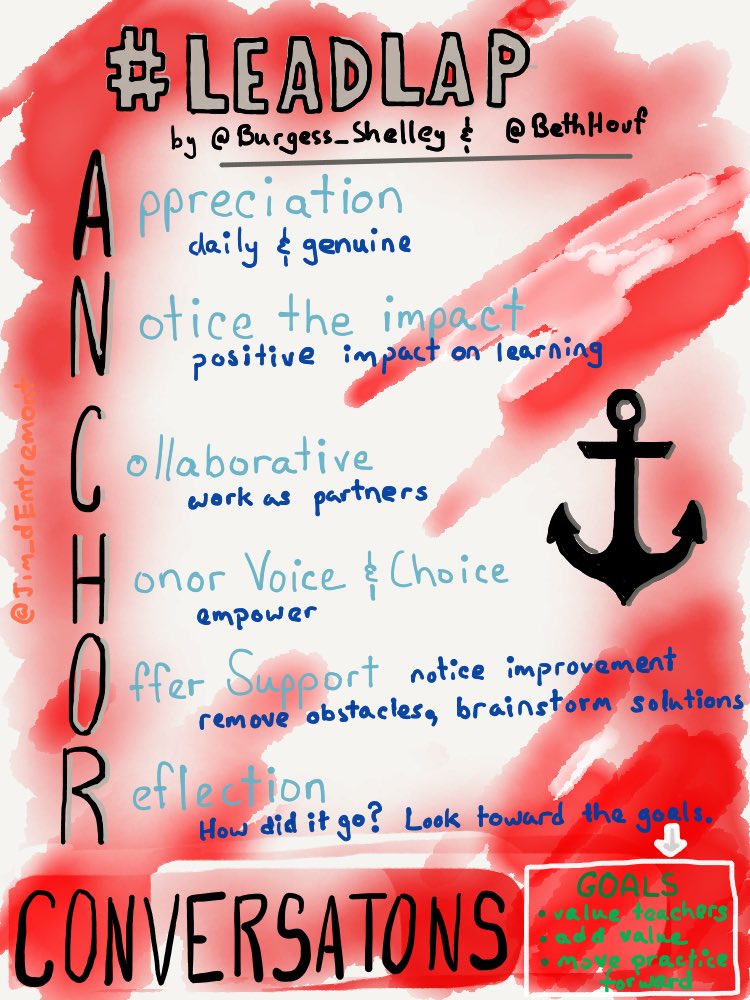
ANCHOR conversations.jpgThis could be used for either exit tickets or tickets to board. Giving immediate and ongoing feedback during class would give students the chance to act on that feedback. This should be highly effective and powerful.

ANCHOR Conversations
Lead Like a Pirate by Shelley Burgess and Beth Houf focuses on developing school culture. One thing they share is ANCHOR conversations.


Even though the ANCHOR Conversation practices are geared toward feedback between adults, I can see how students would benefit from similar guidelines. Embedded in ANCHOR conversations are developing trust, valuing the other person, remaining positive, and highlighting improvement.


I want to more routinely conference with students to provide them feedback. Using the ANCHOR Conversations guidelines will remind me how to maximize my interaction with students, making the feedback more productive.


I look forward to incorporating these three ideas so my students can receive better and more efficient feedback while developing their confidence as independent learners.


If you have had success having students use effective feedback, or if this post has generated some thoughts of your own, please share in the comments. I would appreciate hearing from you.


Sunday, July 30, 2017

Using Mystery Skype to Bring the World into Your Classroom


Student centered and inquiry based, Mystery Skype energizes students to learn about other places.

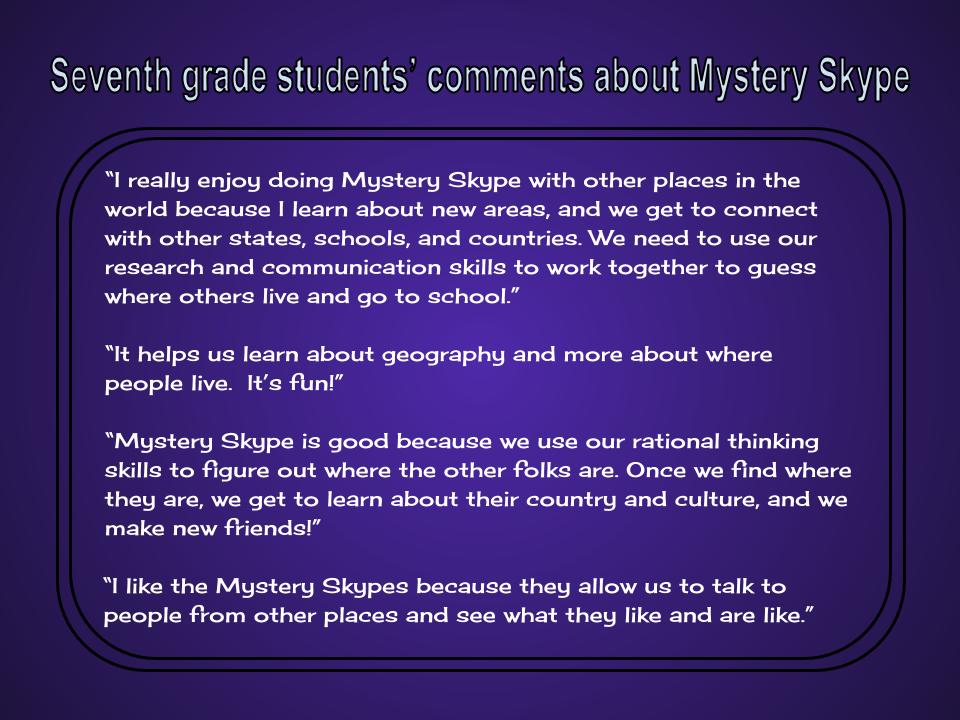
This tool has been useful in teaching world geography to 7th graders as it helps bring the world closer to the classroom, enlivens the content, encourages analyzing information, and develops questioning and critical thinking skills.


IMG_6374.JPG
Mystery Skype in action. The bottom shows students from Belgium on the
computer monitor while in the background (the top) my students collaborate
and view the Belgian student on the SMART Board.
A Mystery Skype is basically like 20 questions during which the two classes are trying to figure out the other’s location.  The teacher sets up the game with another teacher either through the Skype in Education website or social media such as Twitter.  Once a date and time is set - very difficult since no schools have the same schedules and class periods rotate through our school’s - you’re ready to go.

Well...almost.


Having never done one before, I was tentative to just let the students fumble their way through the challenge with me.  I looked online for help and found teachers that structured their classrooms during Mystery Skype.  Paul Solarz and Pernille Ripp gave great suggestions regarding roles and etiquette.


My colleague Sam Mandeville and I collaborated on roles our students would take on, and since we were both tentative of letting our respective students loose on the world, we set up a Mystery Skype between our classes.  Even though we were right down the hall (classes took on the role of city, country so they could actually play) and the students knew one another, it provided a terrific opportunity to put us at ease and work out kinks.  The students were also exposed to the flow of the game.


My students connected with places all over the world including Malaysia, Belgium, Canada, and Singapore.


As we gained more experience, we used less structure by having  a few students record questions and answers and all students generating and asking questions. Even a number of the quieter students stepped right up to the microphone.


The students were engaged, learned more about where they live relative to other places, were exposed to other cultures, and made connections to people otherwise impossible.


Next year, in addition to Mystery Skype, I hope to use the power of Skype to connect my classes with others around the world to collaborate on different topics or projects.  This will further enrich their lives and develop them as global citizens.


If you have had success with Mystery Skype, if you have had other positive Skype experiences in your classroom, or if this post has generated some thoughts of your own, please share in the comments. I would appreciate hearing from you.


Tuesday, February 21, 2017

Project Based Learning: Engaging Students in Learning with Purpose


“Would you rather hear about changing the world, or do you want the opportunity to do so? A story about a world-changer might engage us, but becoming world-changers will change us.”
~ George Couros ~
The Innovator’s Mindset


Student-driven learning.


Project based learning.


Service learning.

I wanted to tackle each of these and make them a priority in my classroom this year. As I was planning prior to the beginning of the school year, I contemplated the role of the United Nations Sustainable Development Goals. What unfolded before me was the opportunity to blend all three together.


The following video was used to kick off a unit of study on the UN's Global Goals: https://youtu.be/ry_9SU0eq9M.


It not only piqued student interest due to their sensitivity to threats on our planet, but it also challenged them to do something about it.


So I put it to them: What can you guys do to help spread the word about the Global Goals?


File_006.jpegThe students came up with a long list of actions they could take, from talking to their families and friends about the Global Goals to holding a community forum. They determined what would be feasible to accomplish in class and decided to create public displays, develop a web page, create promotional videos, and have a public presentation.


The most challenging aspect for me was coordinating multiple classes to work together. In the past I had different classes work on different aspects of a big project, but never before had I had students across classes working on the same endeavor. My solution was two-fold. I had a group of representatives from each class meet and organize the project. They decided how to tackle the obstacles of students from the various classes working on one project.  The second solution was to create areas of communication. Students used whiteboards, sticky notes, Google Docs, and Google Slides to interact and coordinate as they researched and created.  


Not only did students drive the learning and the products, but they had the ability to choose what role they would take in investigating the goals and spreading the word.  In class, after having students individually brainstorm their strengths and weaknesses, I had them all circle up in the center of the room.  I put it to them again: Listen to everyone and determine, together, based on strengths and weaknesses, who should do what.


File_003.jpeg
Student display at the YMCA.
File_001.jpeg
Student display at the Franklin Municipal Building.
They stumbled at first and had trouble wrapping their heads around how they should proceed. (I don’t think they were used to so much autonomy.)  But in the end, they figured it out, without my help, and students seemed satisfied.


Many played to their strengths in video creation or technology, and some pushed to work with their friends.  But others pushed themselves to take more of a risk and opted to speak during the public presentation.


As they worked, students of varying understanding and abilities challenged themselves by staying focused on the objective of the Global Goals: how to make our world better.  Students were diligent and productive. They engagement level seemed heightened.


Students asked for clarification of difficult concepts as they strove to understand.  Many were astounded by some of the information they dug up on topics such as hunger, poverty, education, gender equality, and sanitation. They were moved and motivated.


File_005.jpeg
Student speaking during the presentation to family and peers.
After becoming grounded in the Global Goals, students created, developed, and designed. Once completed, they were eager to know that their work was being shared. In addition to tweeting out their web page (linked here) through our class Twitter account (@Mr_dEsClass), I arranged - based on student feedback - for the displays to be put at the local town offices and the local YMCA and for the students to make a presentation to peers and families.


Naturally, the students speaking in front of an audience were the most anxious about their work going public. The others hid behind the veil of their work being seen from afar. The speakers, however, were exposed on stage.  And they came through brilliantly, rising to the occasion and impressing the audience.


At the beginning of this piece, I shared an excerpt which I had reflected on in a previous blog post:
Tapping into students’ strengths and interests seems to be vital in engaging students.   It may also help lead the students to seeking the opportunity to become a “world-changer.” By grabbing students by their strengths and interests and combining that with touching their hearts, a classroom can elevate a student’s interest and engagement into wanting to make a mark on the world.
My students care; they have a strong sense of right and wrong; they want to help. Tugging on their heart strings through our common human story while allowing students to direct their learning will allow them to accomplish the great things of which they are capable.
The opportunity we took with the UN Sustainable Development Goals touched my students’ hearts, motivated them, encouraged them to rise to the occasion, and allowed them to make their mark on the world.

An email from a parent reinforcing the positive nature of the student driven and project based learning.


One of the student created videos.


If you have had success with project based learning, student driven learning, or service learning, or if this post has generated some thoughts of your own, please share in the comments. I would appreciate hearing from you.

Thursday, October 27, 2016

Leaving the Controversy Out of the Presidential Election

This election season has been tense.  Many have become quite heated about both candidates which has made others very tentative. With unimaginable accusations swirling around the two major parties’ candidates, many teachers have experienced consternation around discussing the election in their classrooms.

Presidential elections have generated positive excitement in the past, even when people vehemently oppose a candidate. Being aware of people’s heightened sensitivity surrounding this election, I contemplated what I should do in my classroom.


As a social studies teacher, I would feel negligent not bringing the election into my classroom during the race for the presidency. A presidential election generates meaningful and long-last learning opportunities for students while encouraging them to take steps in becoming active citizens.


My conundrum: how do we adequately discuss the election while keeping the enhanced controversies involved with this election outside the classroom door?


I decided we need not delve into discussion about the candidates and their imperfections. Rather I took the approach of students wrestling to identify where they stand on national issues. By avoiding the personalities of the candidates, I could better open the students’ eyes to the election.


Students looked at a broad range of issues, sought to come to a basic understanding of the issues, attempted to recognize opposing views on the issues, and strove to identify on which side they felt they may fall. Students struggled to fully understand - I told them they would, especially since most adults do - but I encouraged them to try to get some sort of sense as to each issue and their own view. I reassured them that they manner in which they happened to answer now did not define them, especially with limited understanding.

Student reflection on what she learned from our election 2016 activities.
After they analyzed the issues and determined where they stood, we discussed. Students moved to a side of the room based on their view - some started in the middle because they were torn or unsure. And then...conversation. The big realization for the students was that each side had legitimate reasons for their views. They respectfully listened to one another and considered the reasoning. Sometimes students directly addressed another’s point; sometimes they simply contributed another argument to their side. But sometimes students switched sides. Some in the middle were swayed to a side; some on the opposite side sometimes made the long walk over to the the other side of the classroom.  Students in the middle were able to articulate how they were torn: noticing they felt reasons on both sides of an issue were equally strong.


Students next looked at some basic information defining liberals and conservatives. They again looked at some different issues and determined if they felt the reasons on the liberal or conservative side were more compelling. Next the students aligned themselves on a spectrum from liberal to conservative. The students were well spread out though many clumped on either side of the middle.


By first examining their own thoughts, students were ready to look a little bit at the candidates. Instead of determining which candidate they agreed with, the students determined - issue by issue - which candidates agreed with them. Students discovered two significant points. One was that the candidates, whom they only thought of as being opposed and disagreeing with one another, had some agreement on some issues. This was eye-opening for many.  Another moment of revelation involved the candidates agreeing with the student views. Students saw that each of the four candidates on the Massachusetts ballot agreed with their own views on different issues. So, although they didn’t see themselves as a supporter of a certain candidate, they saw that there was some agreement - and disagreement - between themselves and EACH of the candidates.

To conclude their investigation into the election, prior to a mock election experience, students will practice media literacy skills. They will analyze political ads from different candidates looking for the techniques they have used to sway voters. Students will also propose alternative ways the candidates could have conveyed the same message. I anticipate similar success with this activity as was had with the others.


Clearly, I’m please with both my approach and the students' interactions with difficult content. The activities helped to show that understanding political issues is difficult, identifying our own views on the issues can be difficult, there are legitimate reasons on both sides of the issues, and there was no perfect candidate that matched all of their views.


Hopefully, this learning opportunity will inspire some of the students to become more concerned and active citizens.


If you have been teaching about the election, or if this post has generated some thoughts of your own, please share in the comments. I would appreciate hearing from you.
Related Posts Plugin for WordPress, Blogger...